Immediate Dentoalveolar Restoration (IDR) I Technique
Overview
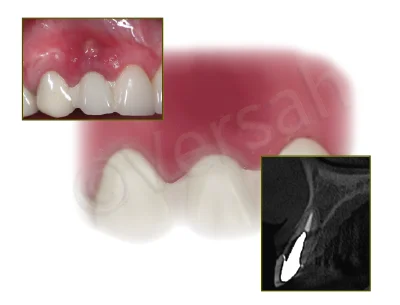
Indicated in cases with poor-quality soft tissue due to fracture and infection in post-extraction sockets in combination with severe bone loss. IDR I
Protocol will be introducing a new perspective to manage these compromised sockets using flapless surgery in a simple way based on biological
response.
• EXTRACT DAMAGED TOOTH AND REMOVE GRANULATION TISSUE AND REMAINS OF PERIODONTAL TISSUE.
• USE THE DENSAH BURS IN OD MODE (CCW ROTATION) TO PREPARE THE IMPLANT SITE AND DENSIFY THE BONE BED.
• ANCHOR THE IMPLANT INTO THE PALATAL WALL.
• HARVEST AND RESHAPE CORTICO-CANCELLOUS GRAFT AND PARTICULATE BONE FROM THE MAXILLARY TUBEROSITY. INSERT AND STABILIZE THE
CORTICO-CANCELLOUS AND PARTICULATE GRAFT INTO THE BUCCAL ASPECT OF THE RECEPTOR SITE.
• PLACE A MANUFACTURED SCREW RETAINED PROVISIONAL RESTORATION WITH AN ADEQUATE EMERGENCE PROFILE. (CEMENTED RESTORATION
MUST NOT BE UTILIZED)
• ALLOW A MINIMUM 4 MONTHS HEALING AND PLACE A SCREW RETAINED FINAL PORCELAIN CROWN.

The CBCT image shows fracture and loss of the buccal bone wall.
Step 1:
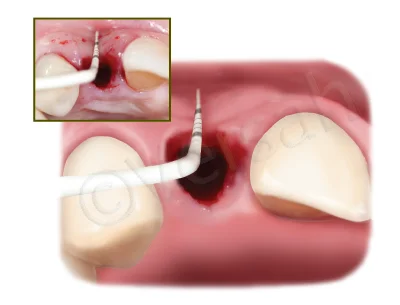
Extract the damaged tooth using a minimally invasive procedure.
Completely remove the granulation tissue and remains of periodontal
tissue by carefully using the curettage technique in the socket. Total
loss of the buccal wall might be common and evident.
Step 2:
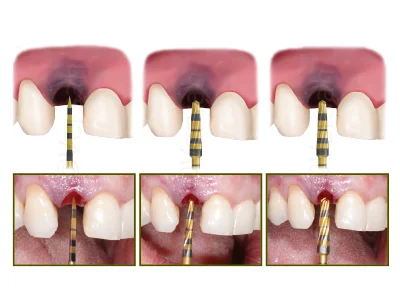
Use the Densah@ Burs to prepare the implant site. Start with the
Densah@ pilot drill, in clockwise mode, to a depth related to the planned
implant length. Depending upon the implant type and diameter, follow
with wider Densah@ Burs corresponding with the Implant System
Drilling Protocol.* Starting with the smallest Densah@ Bur, run the
Densah@ Burs in OD mode (counterclockwise, with speed 1000 rpm with
copious irrigation).
Step 3:
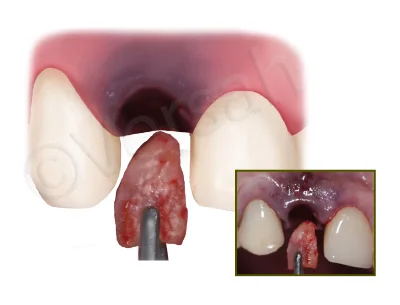
Harvest cortico-cancellous graft and particulate autogenous bone from
the maxillary tuberosity using IDR chisels (IDR kit). Reshape the graft
according to the defect configuration. Insert and stabilize the shaped
corticocancellous graft by positioning it securely into the buccal aspect
of the receptor site so the marrow portion of the cortico-cancellous graft
would be facing the implant.
Step 4:
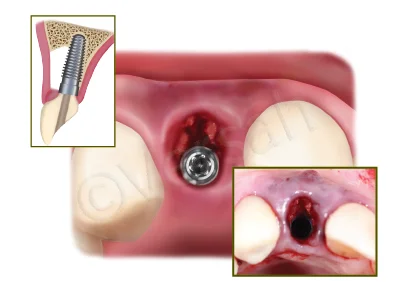
Anchor the implant into the palatal wall in the 3-D position. Compact
autogenous particulate bone to fully fill the gap between the marrow
portion of the corticocancellous graft and the implant. 3 mm of bone
thickness is a desired reconstruction goal of the buccal aspect.
Step 5:
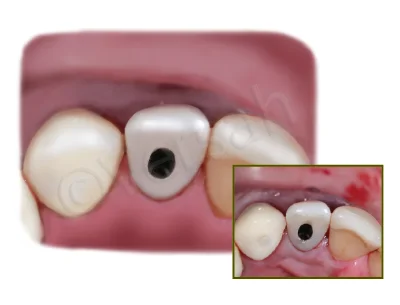
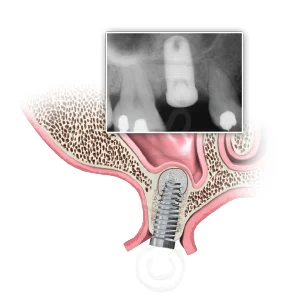
Place a manufactured screw retained provisional restoration with
adequate emergence profile.
Step 6:
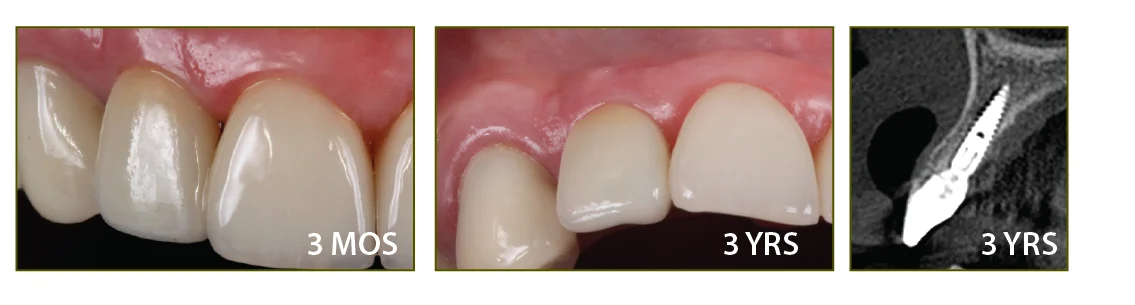
Allow a minimum 4 months of healing for soft tissue to become stable
in volume and have adequate thickness. A screw retained final
restoration is recommended. Maintenance of the anatomical contour of
soft tissue can be observed.